We interpreted Macbeth as an in-depth study of fear and tyranny and as one of Shakespeare’s most brutal and savage plays. Our Macbeth does not enter from battle as a finely-robed, unmarked general who has the sophisticated soul of a poet, but rather as a bloodied, scarred, intrepid, unsurpassed gladiator.
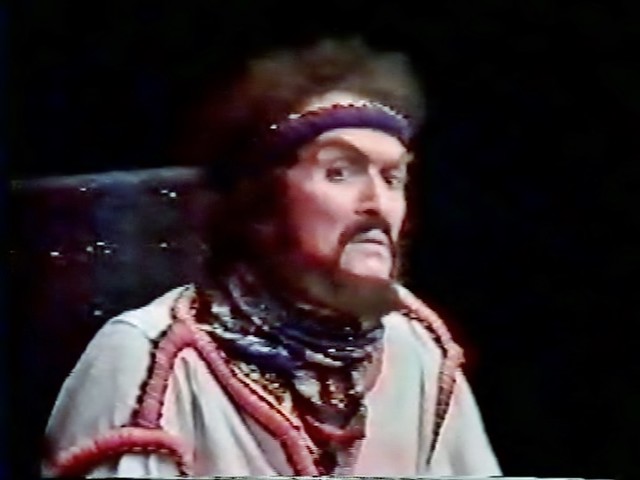 Macbeth’s imagery expresses his subconscious mind but that in no way makes him a poet. Neither is he a victim of circumstances or a man whose fate is determined by supernatural influences or an overbearing wife.
  He is one of those people who would love to enjoy the fruits of treachery without having had to commit the treachery, thereby retaining a clean conscience even as he reaps the results of evil. Macbeth knows what he wants and what he must do to get it.
The idea of killing Duncan occurs to him before he is confronted by the three sisters.  He tells his wife of his desires because he knows that she will give him the emotional and moral support he most desperately needs in order to achieve them.
  Macbeth has no predisposition to murder, merely an inordinate ambition and a lust for power that make murder itself seem a lesser evil than a failure to secure the crown. After he commits the murder it is fear,
  not guilt that infects Macbeth’s dreams and causes his intense paranoia.
Macbeth and Lady Macbeth are devoid of pathos and tenderness. They are not innocent sufferers but self-corrupted and guilty workers of horror.  They do not command our affection or our sympathy, but we should be riveted, astounded and overwhelmed by their passion, brutality and determination. Above all they are human beings and not unreal monsters or evil incarnate.
In Macbeth there are no neutral characters. Every person opposes, allows or encourages the tyranny unleashed by Macbeth. We do not treat the witches as supernatural beings but as the outward manifestation of Macbeth’s inner struggles and desires.
Macbeth’s inner struggle and turmoil are expressed literally and theatrically.

I trained the company not to treat poetry as a strange, peculiar or awkward form of speech but as an absolutely natural and necessary way of expressing the highest and most profound thoughts in the most precise and perfect way possible. We tried to combine the perfect blending of the cerebral and the emotional; the thinking heart as Victor Hugo called it. This, plus a reverence for clarity and form, overcame much of the language barrier we encountered.
Our goal was not to perform only once in a city but to return year after year with the purpose of enriching all our lives. I firmly believe that there is a universal language that can be expressed through the correct combination and execution of text, mind, voice and body.
NEXT

